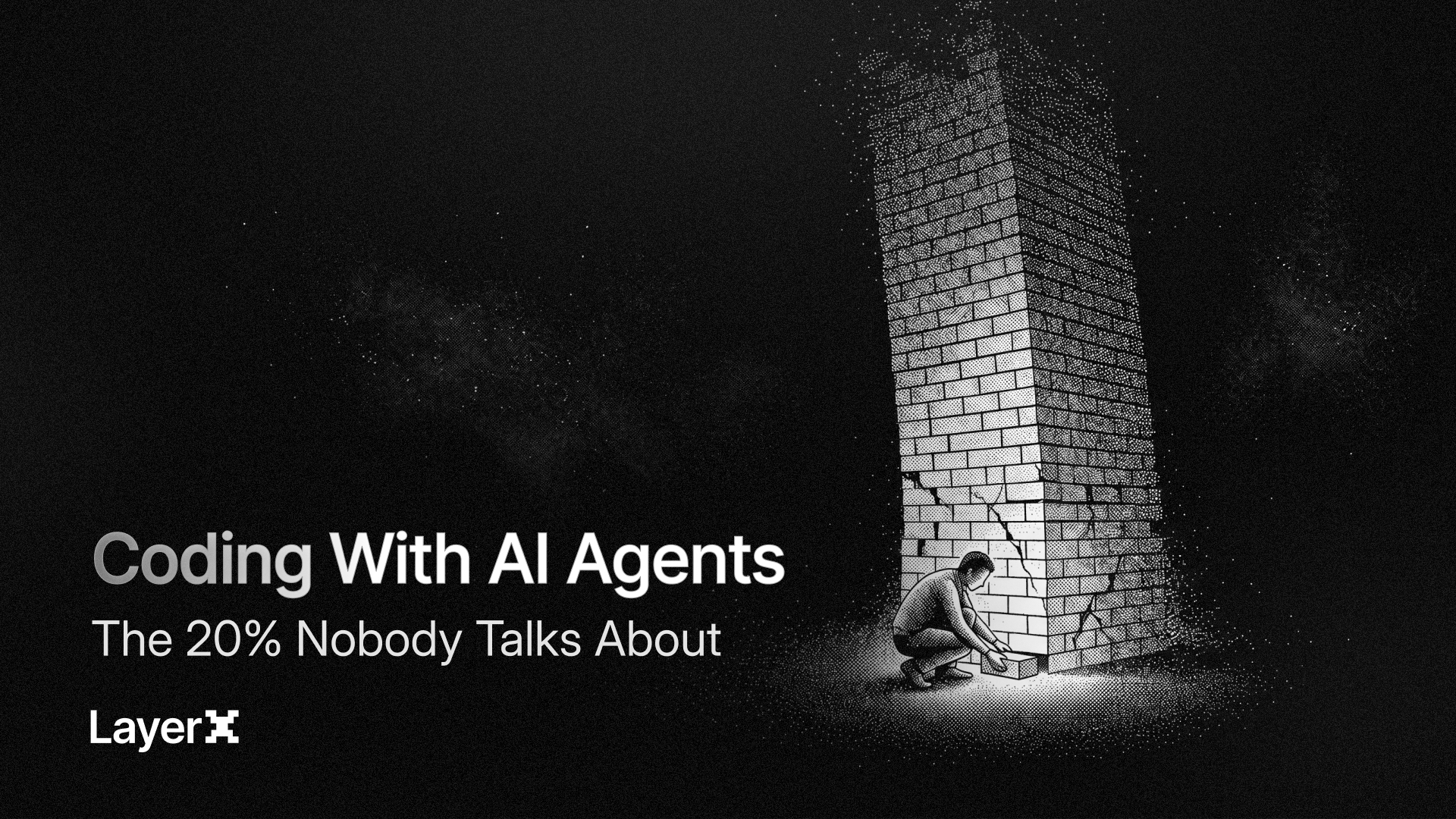
Nobody knows what an agent is anymore

"We're five people and twenty agents."
I first heard this about a year ago, at a dinner, said as a joke. It was funny. Now I hear it in meetings, with a slide, a round number and a straight face. And nobody in the room asks the obvious question: twenty agents doing what?
This is where we are. We call everything an agent. The decision-tree chatbot the company installed in 2019 is now an agent. The script that copies rows from a spreadsheet into the CRM is an agent. The ChatGPT licences the marketing team uses to write posts show up in the deck as an "agentic layer". The word has lost its content, and a word without content is no use for deciding anything.
The industry already has a name for it: agent washing. Gartner used the term to describe vendors who swapped the label on assistants, RPA and chatbots without changing anything underneath, and estimated that out of the thousands of companies presenting themselves as agentic AI vendors, around 130 are actually building what they say they are. One hundred and thirty.
The same Gartner forecasts that more than 40% of agentic AI projects will be cancelled by the end of 2027. The reasons given are escalating costs, unclear business value and inadequate risk controls. None of them is the model. None of them is even technical.
And then there's the part that bothers me most, which is counting agents the way you count people. In 2024, Klarna announced that its assistant was doing the work of 700 customer service staff. It made news around the world. A year and a half later, the CEO himself admitted they had gone too far, that quality had dropped, and the company started hiring again. A Careerminds survey in February this year found that two thirds of companies that made AI-attributed layoffs have already begun rehiring.
I'm not saying AI doesn't change how teams are structured. It does, and it will keep doing so. What I'm saying is that the number of agents measures nothing at all. Nobody has ever presented a strategy that says "we have sixty Excel licences".
We're all collecting tactics
Bobby Fischer has a line that explains this better than any consultancy report: tactics flow from a superior position.
In a game of chess, the beautiful move, the one that ends things in two turns, isn't invented on the spot. It exists because the twenty moves before it, every one of them boring and none of them spectacular, put the pieces where they needed to be. Take one of those pieces off the board and the beautiful move simply isn't there to play.
What I see in companies is the opposite. It's tactic collection. The skill that showed up on LinkedIn, the pilot with whichever vendor called first, the workshop that happened because the board asked what we were doing about AI, the head of AI hired without a mandate. Each of these things gives a pleasant sense of progress. We installed it. We did it. We set up the committee. A year later there's plenty of movement on record and the company's position on the board is exactly the same.
Collecting tactics is more comfortable than deciding. Deciding means saying that a process has been badly designed for eight years, and sometimes saying it in front of the person who designed it.
Concentration of force
There's a second mistake, and it's always the same one.
In 1940, France had more tanks than Germany. It spread them along the entire front, a few everywhere, so that nothing was left uncovered. The Germans took theirs and pushed them all through one place, the Ardennes, an area the French considered impassable and therefore barely defended. France had more force and lost, because the force was spread thin.
That's how most companies are distributing AI. Ten per cent in marketing, ten per cent in customer service, ten per cent in procurement, a pilot in every department so nobody feels left out. Everyone has something, nobody has anything that moves the quarter.
Concentration of force, here, means picking the bottleneck that hurts most and putting everything on it. One. If a quote takes four days to go out and your competitor answers in two hours, the problem is not a shortage of agents in marketing.
In the conversations I have with companies, I almost always end up at the same three questions:
- What is this process, who runs it today and how long does it take?
- What changes in the numbers if it takes half as long?
- How do we find out when it goes wrong?
Anyone who can't answer those three doesn't have a model problem. They have a process problem, and no technology solves that on its own.
This is our focus when we work with companies, whether in the workshops and hackathons we run or in building AI-powered systems and platforms. The best sessions we ran this year were the ones where the word "agent" didn't come up in the first hour. They always start with a boring process nobody enjoys doing and everybody knows by heart. Our job isn't to implement technology, it's to solve problems. Sometimes the honest answer is that a given step doesn't need any AI at all, and saying so is worth more than selling a pilot.
An exercise for August
August is a good month for this. The company slows down, the inbox calms, and what's left is the one thing that's usually missing the rest of the year: time to think without someone asking for an answer by yesterday.
I'd suggest starting at the end, and at the worst possible end. Write down where your company is in 2028 if everything goes wrong. The competitor who answers in minutes and wins on turnaround. The three people who spend the week copying information from one system to another and who eventually leave, fed up. The proposal lost because nobody could find the client's history. Write it properly, with names and with numbers.
Then work backwards and ask what would have had to happen this year for none of that to come true. Whatever shows up on that list is your strategy. The rest is a catalogue.
In September, come back with a problem instead of a shopping list. Once you know what the problem is, the conversation about technology takes twenty minutes. And that part, we're here to help with.