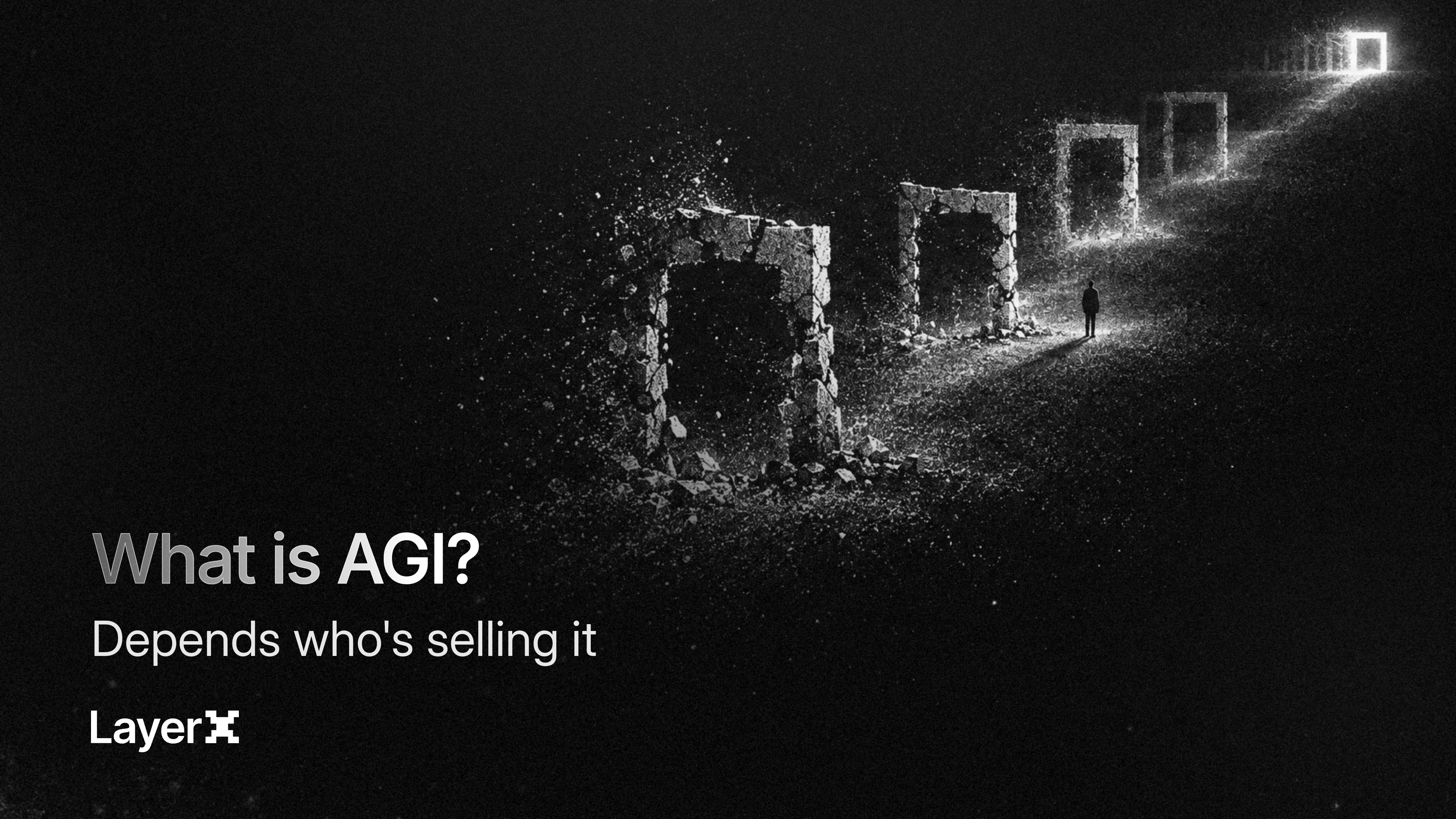
Everyone talks about taste. It's all about trust.

The hot take in 2026 is that taste is the new moat. With AI, anyone can ship. So what wins is curation, judgment, the eye.
That's half right. Taste gets you in the room. Trust gets you the deal.
The adoption paradox
Look at the numbers. AI usage is climbing every quarter. ChatGPT crossed hundreds of millions of weekly users. Every company is "AI-first." Every founder deck has an agent slide.
And yet, ask anyone privately: do you trust it?
Not really. Not for anything that matters.
People paste contracts into Claude, then read every line themselves. Teams ship AI features, then add a human review step. Executives use AI to draft strategy, then override it on instinct. The output is useful. The output is not trusted.
Adoption is not trust. It never has been.
The science behind it
There's a name for this. Behavioral economists call it algorithm aversion, documented by Berkeley Dietvorst at Wharton in 2015. The finding is sharp and counterintuitive.
People will use an algorithm. They will even prefer it for low-stakes tasks. But the moment they see it make a mistake, even a small one, they abandon it faster than they would abandon a human who made the same mistake.
And it gets worse with stakes. The higher the consequence of being wrong, the more aversion grows. A human error feels like bad luck. An algorithmic error feels like a system failure.
This is why your finance team will let AI categorize expenses but not approve them. Why doctors use AI to flag scans but not to diagnose. Why nobody is letting an agent close a five-figure deal alone.
It's not irrational. It's a rational response to asymmetric downside.
Business runs on trust, not output
In business, deals close between people who trust each other. Not the smartest. Not the cheapest. The most trusted.
You buy from the vendor who returns your call when something breaks. You sign with the lawyer who told you the truth last time. You invest in the founder who hit the last milestone.
Trust is the actual currency. Output is the receipt.
AI generates output at near-zero marginal cost. It does not generate trust. Trust is built through skin in the game, accountability, and time. AI has none of those. It cannot be sued, cannot lose its license, cannot be fired in any way that matters.
The school pickup test
Here's the test I run in my head.
You wouldn't trust a stranger to pick up your kid from school. Not even a competent, well-reviewed, certified stranger. Why? Because the cost of being wrong is infinite. No accuracy score gets you across that line.
Now scale that intuition. Would you let AI run your kid's education? Your medical decisions? Your hiring? Your legal defense? Your company's pricing strategy with a real customer on the line?
For most of these, the honest answer is no. Not yet. Maybe not for a long time.
The higher the trust requirement, the longer the human stays in the loop.
What this means for builders
If you're building in AI right now, this is the strategic insight most people miss.
Taste differentiates your product. Trust determines whether anyone actually uses it for what matters. Most AI products today are stuck in the "useful but not trusted" zone. Demos great. Daily use rare. Deep adoption almost zero.
The companies that win the next cycle will not be the ones with the best models. They will be the ones who figure out how to make AI trustable. That means accountability layers, human checkpoints at the right moments, audit trails, real liability, observable decision paths, and the discipline to keep humans in the loop where it counts.
Boring stuff. Unglamorous compared to taste. But it's the moat.
The takeaway
AI will keep getting better. Adoption will keep climbing. Taste will keep mattering.
But for everything that requires real trust, which is to say, everything that actually matters, a human stays in the loop for a long time.
Build for that world. Not the one in the demo videos.